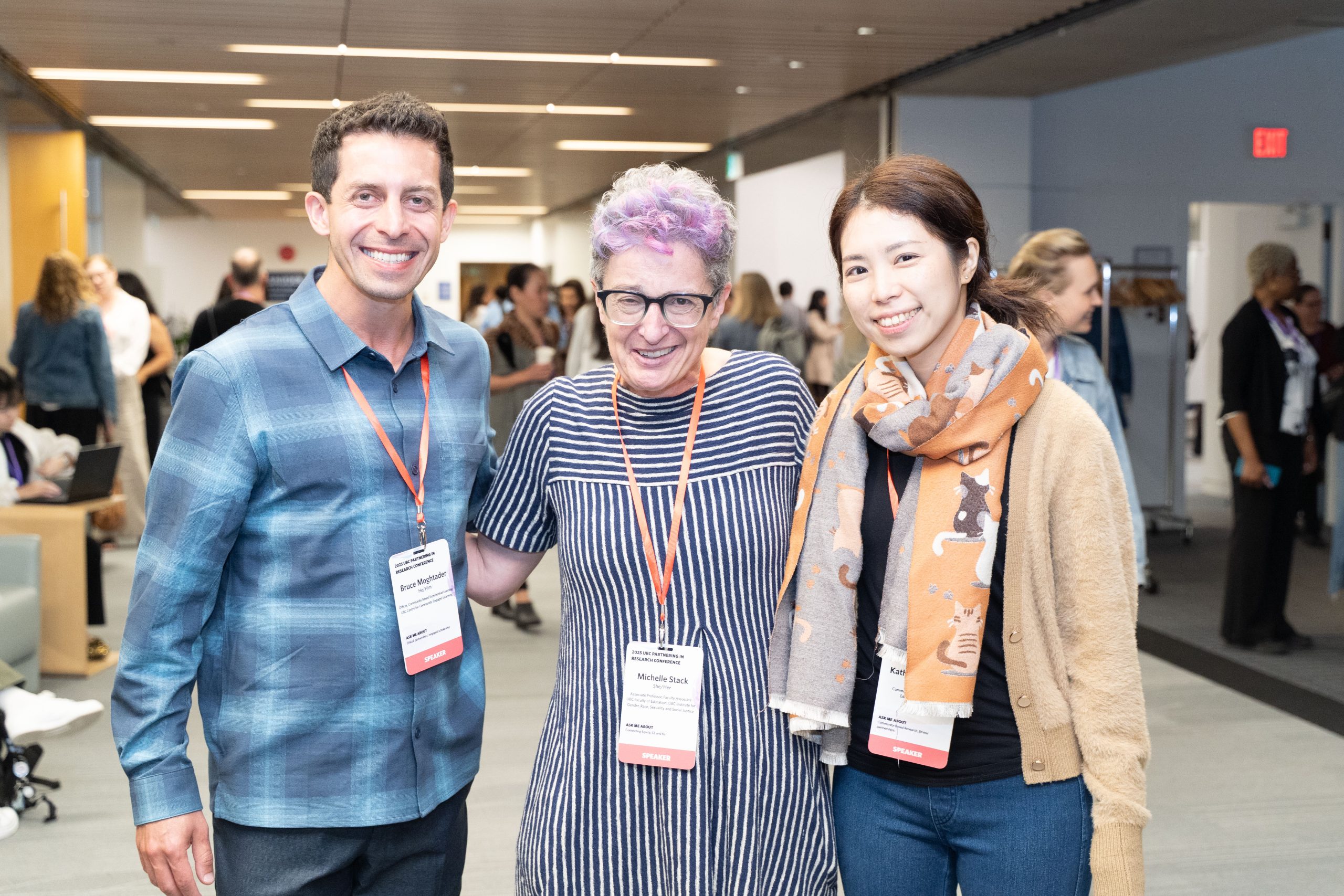
What does community-engaged research look like in practice, and how can researchers navigate the complexities that arise from community involvement? In this special “Ask Me Anything” session, recorded live at the 2025 UBC Partnering in Research Conference, our speakers tackle these questions and more, sharing insights and practical strategies for effective community engagement.
Featured speakers include Katherine Cheng (Downtown Eastside SRO Collaborative), Dr. Michelle Stack (UBC Department of Educational Studies), and Bruce Moghtader (UBC Centre for Community Engaged Learning). As an interactive event, the episode also features reflections and questions from audience members.
Together, they explore what it means for research to be truly community-led, the importance of equitable funding practices, and the need for flexible, renegotiable agreements that reflect community timelines over academic pressures. The discussion also surfaces institutional barriers that continue to challenge community-university collaboration, including tenure and promotion systems that undervalue engagement.
Listeners will also gain strategies for approaching trauma-informed topics, navigating internal community dynamics, and ensuring accessibility across all stages of partnered research.
Find the podcast and the transcript below.
This episode is part of “Challenges in Partnered Research,” a Q&A series by Partnering in Research that highlights individuals transforming policies, practices, and communities through collaborative research. This is one of three sessions recorded live at the UBC Partnering in Research Conference at UBC Robson Square on June 12th, 2025.
Click Here to Read The Transcript
Michelle Stack: I would like to start with a land acknowledgment and just to acknowledge that we’re on the stolen, unceded ancestral lands of the Musqueam, the Tsleil-Waututh, and the Squamish nations and just how important it is. And I’m grateful for the teachings of Atlanta this morning and thinking about how important it is to say those land acknowledgments.
Not as a performance, I think, especially, not especially, but right now when we’re looking at the rise of fascism and, and all the things that are happening. It’s really, I think, crucial to start us in a good way. So, my name is Michelle. Michelle Stack. I’m an associate professor in educational studies, and I was told I’m starting and you’re going to go next.
Katherine Cheng: Yeah. Hi, everyone. My name is Katherine. I am currently the manager of intercultural organizing and research at the Downtown Eastside SRO collaborative.
Bruce Moghtader: Hi everybody, I’m Bruce Moghtader. I’m a community engaged experiential learning officer at the center for Community Engaged Learning. And I have an anecdote to add. We hope that this becomes a conversation at some point and you’re not just looking at us and we could actually ask you questions if it’s okay with you. So, we’re happy to be here and thanks for organizing.
Michelle Stack: Right. So, I think we’re going to start with the first question there, and then we would love it if everybody asked questions. That would be wonderful rather than us reading preset questions. So, the question that got four votes now: do you have examples of stand-up partnerships and research? What makes them exceptional?
Do you want to start?
Bruce Moghtader: I think I have a few that I could speak about, but I could talk about the team that emerged from all of them. And it’s like the opportunity to learn with people. I feel like, the models of participatory action research that really stands out, there is methodologies that come up when scholars interact with people, and those that actually engage in dialogue rather than just going into a community, speaking with people with a set of questions, presumptions about what knowledge is, what we are taking away, really sets the examples. And I think the Indigenous scholars are really leading that work.
Michelle Stack: Yeah. I would say, first, nothing about us without us. I think that research, when I think about, for example, research on Aids and HIV, if you look at where society was, and the homophobia, the deadly homophobia and heteronormativity at the beginning of the Aids crisis, and you look at what it took to change it, it was activists. It was people with lived experiences. It was artists. It was academics. And so, looking at that, it’s just that it takes those different forms of knowledge and ways of being. But most important is that the people most impacted have to be there from the get-go, at that at design, at part of every step
Of the way. And I’d say the other thing is funding that’s equitable. That there’s open conversation when an academic gets money with the community around how that funding is used. The ones I’ve been a part of have included artists, have included academics, activists, people with lived experience, and a sense of shared knowledge and decision making.
Katherine Cheng: Yeah. And I think for me, it’s research that is community-led. It’s driven by community needs and interests and not solely from the interests of academics. It’s academics and community partners working together and being transparent about what each of us needs, and what each of us hopes to get out of this project and working together to negotiate and to navigate.
And there are going to be clashes of interest, and even tensions and power dynamics. And so being able to articulate that and even being clear in your own mind and to each other, why it is important for us to do this research together and what conflicts that might arise in this partnership and what is the mechanism that we’re going to have in place for tackling these kinds of conflicts.
Michelle Stack: Does anyone have a question they want to throw out at
Audience: How do you get started in building community relationships without an agenda? So, I don’t have, like, I want to do research with you, but how do I just build a relationship? Just to start. Just to have a conversation, you know, like, you go to your neighbour and you’re not going to ask them for, like, do you have extra sugar?
You just want to say, hey, welcome to the neighbourhood. How are you? So how do you do that with community?
Michelle Stack: Great questions. […] I think a big part of it is starting with relationships and not coming with, here’s my research project, come and join me, and you can be part of designing it. But actually, starting with those connections, I think about how I grew up in a housing co-op where, you know, it was relationships first and then it was, what can we do together?
And, I guess, you know, knowing the difference between discomfort and unsafe. And so, I think often, you know, it’s easy to do partnered research with people we’re comfortable with. I’d say, actually, as an academic, it’s important for me to be uncomfortable quite often as a white academic in a privileged position. And that takes building a relationship with people, so they’re comfortable telling me I’m doing something wrong or telling me that this research isn’t what they want to do, that they want to do something else.
I think also just organizations, looking at what organizations are out there, what they’re doing, seeing if the values align with your values. You know, I mean, is it an organization that’s more sort of charity focused, or are you more focused on sort of social justice work?
You know, what’s the connect and making a decision there as to how to connect with somebody.
Bruce Moghtader: I would say the challenge for me has been starting with the human. Like, the human person, because I feel like we usually start with research questions. We, you know, we do literature reviews, we find a good questions, but sometimes forget that there’s a human on the other side that, first of all, needs the knowledge. There’s a human that we have to engage as part of knowing that we don’t know.
And that’s why we do research. And then just like what it takes to say hello to people, because sometimes they might not even want to have anything more to do with me. And that’s kind, that they just acted that way. I would say. So. Yeah. So before like that, obviously everybody has interest in knowledge and they’re out there.
But I would say that the human is like the starting place. I mean, as soon as I met you and you said hello to me, Michelle, I mean, we were friends.
Katherine Cheng: Yeah. For me, I think the most important part, which I think is the most fundamental part, is just being there. Being present. If there is sort of an event or some kind of volunteering opportunity that’s already there, then be there, go there and go to the events, talk to people, have a deeper understanding of who is there, who is not there.
What issues that people are the most interested in or working on. And I think another thing is also kind of thinking about how I can add capacity to an organization instead of saying, hey, you know, I want to promote your event and so could you do this and that for me. It’s thinking about how people are already doing certain things and figure out how I can position myself and add to their capacity.
Audience: Sorry, can I add a suggestion? I spoke to a faculty member a couple of years ago and one of the things that she told me was before she started working in the community, she knew that she wanted to work with that community. A year before, she moved to the community and got a job as a dishwasher. And that was her way of integrating and becoming known to the people who may have an interest in the research that she was planning to do later on.
But it really struck me as an incredibly insightful way of becoming in relationship with the community without an agenda.
Michelle Stack: I think that’s really important. And just, you know, realizing that as, Linda Tuhiwai Smith, she’s a Maori scholar that talks about how for a lot of Indigenous people, research is a bad word, right? And so, understanding where people, for very good reason, might be very suspicious of academics, so having to sort of look at and know that history as well and not expect people to have to repeat that history over and over again and to educate, to do that kind of homework, I think is important as well.
Audience: Somebody coming from community, doing research. I take great, that knowledge building piece and a teaching that was given to me from a colleague who’s Indigenous, who’s academic, well respected within the community of research. She said. Darren, we can’t do research together until we’ve had ten cups of tea, but it’s about getting to know before we even get to research. As somebody coming from community doing research, I take that knowledge building piece and a teaching that was given to me from a colleague who’s Indigenous, who’s academic, well respected within the community of research. She said, Darren, we can’t do research together until we’ve had ten cups of tea. It’s about getting to know before we even get to research. And you might have to have more than ten cups when I introduce you to the rest of my community, and it can take time.
Audience: This is maybe a little bit off topic, but I used to work at UBC, and the tenure and promotion process did not acknowledge, and it was a struggle, to have community led or, you know, engaged things count towards tenure and promotion. And I don’t know if that’s changed, but back to the dynamic with community and having, in my case, Indigenous-led research, do you have any comments about where UBC is at, at this point?
Michelle Stack: Yeah, a long way to go, I’ll be honest. I think there’s been some progress, I think, in terms of acknowledging community engage research and Indigenous research. I do think, I mean, you know, a lot of this is sort of thinking about how can the university have courage in a sustained way to do this work.
And so, you know, I think about, for example, how black academics have worked for decades to talk about anti-Black racism, and suddenly, when George Floyd was murdered, the university discovered anti-Black racism and there were all sorts of grants or statements put out. Great, but they should have been put out based on partnered research decades before.
And what could we have done as a university if we weren’t so episodic in thinking about ethical partnered research. And so, to me, that’s a really major issue. And it’s a major issue in terms of trust with communities. It’s this sort of sense of academics coming in doing something that’s new, when for the community it’s been, you know, it’s not like, anti-black racism is new or racism towards Indigenous people is new.
I mean, for example, when the Plain site report came out, all of a sudden there’s attention to anti-Indigenous racism in health. Great. But there were Indigenous academics and community members talking about that for decades. And so I think part of this is saying, this isn’t like an episode where, okay, we’re going to do research on this topic because there’s been media attention to it.
And then, you know, thinking about the apologies that that have been given in the past, how academics that did partnered research, it was risky, how they were treated back then, and sometimes ostracized, and then looking forward to today in terms of, how are academics treated in community that are doing work on disability justice, that are doing work on Gaza and the genocide that’s happening, how are they being treated? And I think that we really need to make those connections to do community research that’s not sort of based in the needs of the institution and that’s not performative. So I don’t know. So, yeah, I think more work is needed on tenure promotion. That’s the long answer. My rant.
Bruce Moghtader: And I think what comes up is this theme of time, you know, because people feel like they have to publish. And this Western notion of time that just pushes universities to be research intensive is doing a lot of harm in the community. It’s absent mindedness that we just got to push. And people, like, of course, assistant professor, I want to be an associate and then I’m going to be a professor.
You know, I got this job and I’m hanging on. But that very notion of how the university is designed, it’s just a fiction that is soul-breaking. And then you get to the big universities like UBC and U of T, and everybody’s just like running faster and faster. And then you look and you like, okay, I have the nice title now, but now I have to run faster too.
Like you just you’re habituated to just doing things because you’re in a research intensive university.
Michelle Stack: There’s been times where I’ve been working with organizations in the Downtown Eastside. It’s like, why are you in such a hurry? Right? It’s like, yeah, good question. Why am I in such a hurry? Where you get in this state? And like, I like what it really like what? Why am I doing this? So sometimes feeling like things are necessary as academics that actually are, that we can kind of push against and actually have to if we’re doing, if we’re actually doing deep sort of community work.
Audience: Considering the communities that we research, sometimes we are dealing with very delicate topics. And I talk about this because I research rape and domestic violence. So in cases like this, often I feel like this wretch that comes from academia is not respectful towards like people that are, of course, being victimized, when we need to ask them very deep questions about their experiences. I don’t know if you have any experience on that, but I would love to hear from you and your insights on this. Thank you.
Katherine Cheng: Yeah. So I think for academics, it’s very important for academics to kind of think about, am I asking these questions for my own scholarly interests, or am I these questions to work in solidarity with my partners? And another thing have seen other scholars do is be very transparent in the beginning of the research and in their consent form, kind of laying out, these are the kind of questions that we are going to ask you during the research, so you know what you’re signing up for. And also being very clear that while, perhaps you won’t directly benefit from this research. So, let’s not talk about how you will have the opportunity to contribute to this amazing research, advancing science and whatnot, not let’s just drop that. Let’s just be very clear that, yeah, it’s very possible that you won’t directly benefit from participating in this research.
And so that’s kind of like just going back to the transparency and being clear about your own interests and your goals so that people can decide. And what I’m trying to say, you know, is so that people can decide on their own. Also, being mindful that while sometimes, you know, there’s a lot of complexity in terms of why people decide to participate in this research.
Right? Like, informed consent is actually a very delicate matter in community-based research and participatory action research. And I don’t want to kind of like, make it trivial.
Michelle Stack: And I would say this is where, you know, working as a team is really important. Like with people with lived experiences. You know, and this is where it’s tough to in terms of who are you talking with, like, you know, I think sometimes it can be tempting to talk to people with lived experience that we’re most comfortable with.
You know, there’s a whole range of people with the same lived experience that come with different perspectives. Some might be angry, some might be hard to understand. And so making sure to talk to people that maybe are very different from ourselves. And figuring out how to do that. I would say before I would ask any sensitive questions, I’d be going for coffee or tea with people,
I’d be bringing food. I went to a few meetings with the transformative health justice group. There were women that have been incarcerated, there was academics or community activists. And it was just beautiful how everybody sat around. And there was a weaving activity one time, and medicinal herbs. And then we talked, and it was sort of organic.
It wasn’t like people being asked questions. Right. So it was just asking, getting to know each other. So I think part of it too is like research can be through photos. I mean, I’ve done projects where it’s like, take a photo of when you feel connection or take a photo of what you feel like when you’re in school.
And that can be a way people can then enter the conversation how they want, in ways that are, particularly when we’re talking about sensitive issues. And then I think your own positionality too. So, I mean, I think about doing research in a school district with women who are recent immigrants. Most of them are refugees. And you know what I asked?
Well, how do you feel about Canada in schools? Oh it’s wonderful. It’s great. Right. And so I’m like, okay, they’re telling me what they think I want to hear. And I said, look, I, you know, and I could tell they were nervous. And so, you know, like I had I had a colleague who, who herself is from Kenya is a black woman who she then I left for a while and said, okay, you can be honest.
And so once she told them that there was comfort. So I had to look at my own positionality, right? I mean, I have to look at, I’m coming in the room, I’m privileged. I’m, you know, and I’m asking people to take a risk and tell me about racism they’re experiencing. Well, you know, they’re going to have to get to know me.
I’m going to have to build up that trust. Or they’re going to likely out of safety, tell me, particularly in the moment we’re in what I want to hear. So, I think that particularly on sensitive topics that are really dangerous, for people to speak about is how do people perceive me?
Not how I want to be perceived. But also, how do people perceive me.
Audience: Just to add to that, in relationship to your question, as somebody who comes from community does research, it’s really important that you put together a community advisory committee from that community you want to research and also train up peers to actually ask those survey questions, because as somebody who doesn’t have the question you want that whole survey, if I don’t have any of the lived experience, I’m asking it from a certain viewpoint, a certain lens, and that trust relationship isn’t there.
Our hour together, our half hour or two hours, it’s just not there. But as a peer, when you say, when I take this medication, I get this bellyache, I know what you’re talking about. My nod of understanding is assuring you that I’m not dismissing you, that I understand what you go through. But it’s your words I want to capture at this point in time, because it’s your moment to share.
Michelle Stack: Yeah. And there’s one thing I just want to add is I wish we actually had a word or some way to talk about community that talks about power and complexity, because I think sometimes you say the word community and it’s warm and fuzzy. And as we know, it’s not right. So, part of you know when I say, oh, I’m consulting with this community, like, who am I consulting with, right.
Because it can be that I’m consulting with people that are of the same social class that talk in a way that’s acceptable to academic norms. I think that’s a really important one. Division and power in a community. And do your homework on that.
Bruce Moghtader: And I will maybe add to what you said, I think if I can’t answer the question of why am I in this room sitting with these people, I don’t think experience is a sufficient criteria to bring people with lived experiences into certain rooms that they might not feel comfortable in, but you’re comfortable because you have an interest.
And I think I would sit very long to see what would I answer when they ask me, why are you here? Where are you asking these questions? I don’t think the answer that want to tell you’re story is a sufficient story to be in that room with those people. As somebody who has lived with poverty, maybe poverty is something that I could research.
Maybe I understand it, but I don’t know the different types of poverty. And it’s really hard to be in spaces where people’s emotions are on the table. You see cards, you don’t know why they’re speaking. You’re already looking at your content analysis table for your qualitative research to write this down. It’s just two different worlds, again. And
I feel like it really is. I’ve been on both sides. I know exactly what that person is going through. So it’s not till you’re getting research that you realize, what’s the point? What am I doing this for? For the $25 gift card? No thank you. Because there is that emotional wound inside, and maybe they’re not comfortable opening it.
Yeah. So don’t call them community. I think to some extent their individual sitting there in front of you sometimes. And I think that is also important, because community just neutralizes that experience.
Audience: I have been thinking a lot about working agreements with community partners, particularly written ones. And a lot of the resources I see, it isn’t listed as an important step? And I see some of the value in being on the same page and setting expectations. But I’ve also been thinking about like, is this kind of like a colonial academic approach to this idea of building safety?
Like, we have it written down, we have a contract like, okay, now we can move forward. But I see it a lot as something that we should be doing. And I guess I’m wonder what your thoughts are on that. And if there are other ways and what your experience has been with kind of setting those, quote unquote agreements?
Katherine Cheng: I think how you set up that agreement is very important. Whether it is something that you do after you have spent a lot of time being with your partners, hanging out with them, hearing their stories, getting to know them as a human being or as human beings. And, I think an agreement is not something that’s kind of like, you know, like once and for all set in stone.
It’s something that can be changed, depending on what comes out of the collaboration process. And I think that sort of like a more dynamic approach is perhaps more important, just kind of knowing that this is a work in progress, things may change is not something that an academic is imposing, it’s something that is a result of collaboration. it’s something that is a result of collaboration.
Michelle Stack: And I would say looking at power. I remember doing a project with a school district and they said, okay, we want to hear from youth. But then I came to realize they wanted you to abide by the code of conduct. And so, so we had a really good discussion, but if I had like, you know, educators and the school principal and the youth all in the same room coming up with guidelines, right?
I mean, on one hand, you might say, oh, they’re the school community. Well, they’re coming from radically different positions of power in that room. And so, the fact that youth that, you know, say, oh, yeah, this is great, it might not necessarily be great, it might be that there’s people who will be grading them who are in the room.
And so you know, I think we have to think about those things with agreements. And sometimes it might mean separate meetings. Right. So, you know, like the idea of caucuses for example, where you might, you know, have an Indigenous caucus, you know, a caucus of people who identify as disabled. So that they’re not having to explain things, but also where you can actually talk about those power issues and power differences rather than thinking, oh, we’re all in the room are all equal here.
Everybody has a voice when that’s just not the case, right? Like it’s not. You don’t have a room where everybody is equal. And generally, people that think they’re everybody’s equal are the ones that tend to have the most power in the room.
Bruce Moghtader: Just to add to that, power. I think the university protocols and the applications that we fill up, those are ours. Anytime I meet with people, I ask them, what is your protocol? This is the consent form that you signed for me. Let’s write one for you with you. And you tell me what your protocols are because the institution is, just as you said, absolutely just runs by its own mind for its own purposes for most of the time, although it’s doing service. I mean, that’s part of the things that I’m doing. But with each person that I talk to, every now and then, I go, these are the protocols that I got my application approved. What protocols should you bring to this table? What would work for you? This is my commitment to you, and you tell me what that commitment is.
Michelle Stack: And there are some really wonderful examples of people that have done this. I mean, I think about this scholar, Doctor Amy Parent, or Joanne Archibald, around story work who have done, really, and that’s the other thing I think, too, it’s important to realize people don’t have one identity. Right? Like somebody can be an academic and be from a nation, from an Indigenous nation that are working many boundaries and identities. So, thinking about those folks as well.
Katherine Cheng: I kind of felt like this is very connected to one of the questions here which is how do you think about accessibility in part partnered research? Because I feel like very often accessibility could be framed in terms of like, well, so I think there is like a basic and very important level of accessibility, which is, for example, through plain language summaries, talking about research that’s free of jargon, childcare and everything.
These are all very important. But I think there’s also a deeper level of accessibility, which is really thinking about who is at the table, who is not at the table. Are we sort of inviting Indigenous and racialized folks to the table without actually being able to work with them to see how the table should be set up in the first place.
And very often, Indigenous and racialized folks are being asked to do all this knowledge work and emotional work without having the space for setting up the table in the first place. And really thinking about how sometimes inclusion could be harmful as well when it is not being done well. And, you know, accessibility is not just about including people is really thinking about how we can include people in a meaningful way to kind of like challenge power dynamics and to make room for each other.
Michelle Stack: Yeah, maybe we get rid of the table. Like, it depends. Right. So so yeah, I think that’s really important. Simple notions of inclusion can actually lead to exclusion. Right. And so yeah, I think about a group of youth I worked with who all identified as disabled.
And it was really interesting because it’s like, oh, well, you have to have other youth. I worked with youth where they none identifies as disabled and that’s not an issue. So why is this seen as an issue for youth to be able to talk about their experience, not have to explain, not have to be seen as, you know, having deficits.
And so, sometimes having caucuses or separate groups can actually be more inclusive and, and in some situations, I think.
Audience: Thank you. I actually have a question with regards to the notion of partnered research, especially in the context of other names that I think are being used, not only in the literature but also in practice. So, for instance, when we speak of inclusion and there’s been interest in participatory research that became participatory action research, and we have a distinction that we make between community based participatory action research and institutional PAR, where agreements, for instance, written forms, are so much easier with institutional partners as opposed to communities and community based organizations that might be led by people similar to academics with education, work experience.
But from my experience, for instance, working in communities that are either used to oral tradition or might be semi-literate or illiterate, then those written agreements are totally useless. And even with some institutional partners, it seems that a constant renegotiation or regular renegotiation of those agreements are important, especially when it comes to funds, which I think Michelle had mentioned earlier.
And when it comes to participatory action research, and I’ve written about this on some occasion, when academics lead PAR, it’s so easy to remember the research and forget the action whereas in communities, it’s the action that is often the priority. And the research comes to secondary and often forgotten. And so I think this is where the power dynamics and understanding different timelines, different mandates, different priorities, is important to keep in mind constantly. And they also get renegotiated in the course of that process and sometimes the research outputs in whatever form, might not be as important as some other after effects or after thoughts that are not even included in the actual research. So what do you think then, of that flexibility of renegotiation?
Under what conditions does it work or if its rigidity can also be a potential, aspect that could be done. And under what instances would that have to happen? Or, I always go with flexibility, but I’m not sure if you think that that’s the case. Thank you.
Michelle Stack: I tend to go with flexibility, and what the group wants. But the written I totally agree. I think that some of the most powerful group agreements I’ve seen, well, one was a collage with a group I was working. They said, no, we don’t want to write things, but we use magazines and pictures and drawings to sort of talk about how we wanted to be together.
You know, so I don’t think it has to be written, and it definitely has to be renegotiated or rediscussed on a regular basis. And I think consent is an ongoing process that somebody can say, yeah, I know I said yesterday, I want to do this today, I don’t. And that is fully, and has to be, I think, central to any research which might mean I don’t get, you know, where it’s like, okay, this isn’t working for people, right?
Or it’s a complete overhaul and this isn’t what we’re going to do. And I don’t get an article right. And I do think that’s part of it too, as academics is to look at the choice we have. So, for those of us that have tenure in particular, I think is saying we do have choices, right to say, okay, I’m not, you know, I’m not going to get married, maybe I’m not going to get this and that, but to do actual community research requires making those decisions, like, where do I put my values?
You know, it’s different for people that do not have that security, but, I do think that I’ve seen agreements that are song, that are collages, that are photographs, and that sometimes we might sort of say, hey, let’s why don’t we revisit this and not necessarily call it an agreement, but just how are we being with each other?
How are we learning from each other? How’s that going? So it’s not put in terms of a disciplinary thing, because I think sometimes agreements too can sort of seem like disciplinary language at times. Right? Like, don’t do this, don’t do this. For people that are often told not to do things.
Bruce Moghtader: I just love that you talked about that, because I think the tokenization of the work with people that we give them an honorarium for two hours of their time might not be sufficient. So usually the real reflection is to make a list. What am I taking away? What am I giving back as just a human being? And maybe that gift is sitting with the person for tea because everybody loves to be listened to.
And if I’m unable to listen, then that’s the end of that relationship. And then the last thing is, how am I going to sustain this relationship? Because if I’m not able, and it’s going to be transactional, then there is harm being done. Is just somebody trust you again with their knowledge and you walk away with another paper.
Michelle Stack: And I think where it can get really exciting, like where I get really excited, is when people that have all this experience that are co-researchers doing the research, that they’re the ones that talk to media, that talk to policymakers, and that’s where it can have such an impact too. So I think sort of looking at, again, who’s doing what and what assumptions might be made in an agreement, to like, that the academic will speak to the research or whatever and kind of a time of how we’re going to work together, like how do we want to be together can be a time to really challenge some of those assumptions as well.
Audience: Just a comment. And kind of echoing some of Nora’s points that when we talk about agreements, we tend to think that they’re binding, right? To do or not to do something. And they do have to be binding up to a point, right. But then they also have to be loose enough, obviously.
So I think one of the most useful things I’ve read about community partnered research is the work of Eve Tuck, who talks about and emphasizes the right to refuse research. And what does that actually look like? And, it often looks like not answering your question. Not like we’re not going to continue talking and interacting, or I’m going to answer this question in a roundabout way, because I don’t actually want to hit on the sore spot you just touched, which is often trauma-based.
And I think sometimes when we talk about trauma-informed research, we’re only thinking about the side of the person being asked to question, not the researcher. You know, we come to these with our own traumas and we’re often that’s often shaping how we’re asking a question. So we’re also refusing some of our responsibilities, which we need to, right.
But what I think Nora’s question really helped me think about was the point about the individual, the collective, but also the institutional. And we’re almost always working through those three levels. Right? Even though in the immediate moment we’re just talking one on one to somebody who we feel some good trusting rapport with. But the institution is also there, ruling and regulating whatever interaction we’re having.
And so is the community. And the community is made up, as Michelle stressed, of conflicts, of exclusions and inclusion constantly being redrawn. Right. But I just want to underscore that point about refusal because that too has to be part of the agreement.
Michelle Stack: I think that’s a really important point. And on the institutional, what would it look like if we thought about thinking as an educational ecosystem? I mean, this is one thing I really think we often think of institutions, and working with community organizations, what I hear is like, well, where do I go?
Like, okay, so I want to do partner research. I don’t know where to go, like UBC competes with SFU, you know, and so for example, in the Downtown Eastside, you have Langara doing good work, Emily Carr, UBC, SFU. But what would it look like to have a one stop shop where people could go and say as a community, we want this work done rather than academics saying, we want to do this work with you, or both ways.
But sort of going beyond institutional needs to the needs of groups that are underserved that contribute hugely to universities as research participants, as service worker, in all sorts of different ways, to sort of say, okay, what what are the needs and aspirations of those folks that are being underserved by their educational system.
I think that that’s something too that could get at also sustaining partnerships, because that’s one thing too, is these short term partnerships that really create, for good reason, cynicism. How could we mitigate that by thinking more as an educational system rather than institutional needs.
Audience: I’m thinking ahead. I’m involved with a project that is looking at 20 and Indigenous communities around the province. And I’m thinking ahead to the part where the findings are communicated, mobilized to use a jargon. And then I’m worried about the capacity because I don’t want to talk about it. I’m not Indigenous.
I want the Indigenous folks, ideally, if they are interested and want to talk about it. But the capacity levels are all over the map and very low to be on the average. There’s a few of these communities with more capacity, but they can’t speak for everyone. So it’s a bit of a dilemma about how the work is then shared.
Bruce Moghtader: Have you asked them what is useful from the work that you have done with them that they might want to contribute more to? I think there’s a set of questions that you probably have a better ear to listen to the, about what they need from the research, too. So sometimes when we talk about communities, it’s usually the paper, it’s the academic writing.
Then there is the tools for the community to build, to highlight their assets and to tell that a story of the strength that they have. And then there’s a third category that is not on paper. It’s a category of commitment, that I will come back here again after this is done. That is, you don’t necessarily need to say it, but it’s felt, you know, they feel it.
And I feel like if the third category that is not ever on paper is answered for you, that will reignite that commitment that you begin with again, that this is not the end again, that I’m not adding to your capacity because I want you to read this paper to make sure the information is right. I think that’s the third category that is like usually missing in partnership in research.
Like, how am I going to sustain this with you? Because this is not the end. And what do I have to give back? Because you have given me so much. You’ve been so generous. I think those questions change the picture of the transactional exchanges that we have in research.
Michelle Stack: I think that’s a good way to end. Thank you so much, everybody for coming. Thank you.
- Stories